Thursday, 28 April 2011

Wim Crouwel at the Design Museum

If you get the chance, take an afternoon out to visit the Design Museum where the Wim Crouwel retrospective is showing until July.

Regarded as one of the leading designers of the twentieth century, Crouwel embraced modernist principles, producing a wide range of typographic designs that influenced the course of graphic design through the 50s and 60s and continues to have resonance today.

Heavily influenced by the Bauhaus and the modernist design work of Jan Tischold and Josef Muller-Brockmann, Crouwel’s initial work as an exhibition designer gave him a great sense of spatial awareness that he brought to his poster and programme designs, first for the Van Abbe Museum in Eindhoven, and later for the Stedelijk Museum in Amsterdam.

Wim Crouwel's work at the Design Museum
Gifted with a sympathetic museum director who allowed him the freedom to develop a signature look, Crouwel developed a structured grid system which acted as a unique template for the Stedelijk Museum's graphic identity. The logic of his designs distil the subject down to its absolute essence, yet often the poster layouts contain an experimental element or visual pun, playing off the exhibition title or the subject artist's style.

In 1963 Crouwel founded the multi-disciplinary design agency Total Design creating the identity for numerous Dutch companies, working for clients such as IBM, and typeface commissions for Olivetti. He was instrumental in leading a controversial redesign of the dutch telephone book using only lowercase letters - offering major savings on ink and paper - but one which failed to find favour with its audience.

New Alphabet (redrawn)
Whereas his strength lay in designing one-off grid-based posters and wordmarks, primarily supported by easily readable sans serif type, his interest in letterforms as graphic objects led Crouwel to design the radical New Alphabet typeface as a visual experiment. Based on the look of type as seen in emerging computer systems, it appeared almost alien, a cipher script of vertical and horizontal lines. This almost Illegible font challenged the design establishment and provoked debate amongst modernists - a debate which Crouwel was happy to engage in - openly admitting to placing visual aesthetics above function.

(Although never meant to be really used, New Alphabet was subsequently redrawn by Brett Wickens and Peter Saville for the Joy Division album, ‘Substance’ in the late 80s.)

Some of his work has dated, but there are many pieces that still retain a freshness and vitality and demonstrate a clarity of thought. Set beside contemporary work by design groups 8vo, Cartlidge Levine, Studio Myerscough and Peter Saville, the influence and legacy of Wim Crouwel can be clearly seen.

Thursday, 7 April 2011

Structured writing

Be clear what you want your writing to say before you start to write it.

What impression are you trying to create? Are you just giving information, or do you want your readers to do something? Who is your audience? Who will read your writing? Think about these groups, what interests them and what you want to say to them. How do they like to receive and use information? Is the visual impact important to them or not?

Inverted pyramid writing
Most people are taught to write by setting up a proposition, building an argument and coming to a conclusion.

However, this presupposes that your reader has the time to read your content all the way through to the end. However, most people skim and scan text in order to extract the salient points as quickly as possible.

Journalists and web editors recognise that their readership is transient and have adopted the concept of inverted pyramid writing to communicate with a time-poor audience.

This style places the most newsworthy information at the beginning of the story and orders the remaining content based on relative importance.
  • Story lead (who, what, why, where, when) > Supporting information > Details
Using this structure enables the viewer to grab the core message quickly. In turn, your design should clearly frame the content and enable skimming and scanning.

Writing for the web
People don’t read websites in the same way as they read books or newspapers. They tend to scan, looking for the information they want, and ignore long documents and large blocks of text. You can make it easier for your users by following a few simple pointers:
  • Put the most important information at the top of the page
  • Use sub-headings, bullet lists and links, so people can find topics easily
  • Use plain English and avoid jargon (remember, you are writing for everyone, including people whose first language may not be English)
  • Keep it brief – internet users like short bites of text
  • Keep pages short – don’t make people scroll down too far on any page. 
  • Use short sentences
  • Make sure your content is relevant – do I really need to include this?

Tuesday, 15 March 2011

Bass notes: Saul Bass at London's Kemistry Gallery

Saul Bass is acknowledged as one of the 20th century’s most successful corporate designers, responsible for (amongst others) the logos and identity systems for AT&T, United Airlines, Alcoa and Warner Communications.

Bass’s work is instantly recognisable for its directness, its simplicity and the way it makes its meaning felt. Breaking all conventions in the 1950s and 60s, Bass virtually invented film titles as we know them today, and he was the first to synthesize movies into compelling trademark images.

Looking at his poster designs on display at the Kemistry Gallery, I wondered how much his style was driven by the silk screen process and the need to reduce the visual idea down to it's simplest, most expressive components.

His later posters were more colourful and visually complex, yet seemed to have less impact.

In a period when graphic imagery can be easily manipulated electronically, Bass reminds us that to cut through the visual clutter, a strong idea is always at the heart of a great design.

Tuesday, 8 March 2011

Structured content

The organisation of content directly affects our ability to receive a message.

Some people want to know all the details, others just require a general understanding. Structuring information in a way that provides the viewer with multiple levels of understanding is a fundamental principle of communication design.

Will the editorial approach be story, news or feature? Narrative or bullet point? Q&A or monologue?

Understanding the structure of your content, having an overview of the likely sequence of content types and applying the LATCH and AIDA communication models will help you to structure your design.

LATCH and AIDA structural models
There are two standard models for organising content. Created by Richard Wurman, LATCH (Location, Alphabet, Time, Category, Hierarchy), identifies five key ways to categorise information and is generally used at the document level. AIDA (Attention, Interest, Desire, Action), Developed by E St Elmo-Lewis describes the sales process and is a generally used in advertising and at the story level in narrative.

LATCH (Location, Alphabet, Time, Category, Hierarchy)
  • Location - Structures information based on spatial positioning ie. transport guides, the human body. Use location when physical connections are important to understanding.
  • Alphabet - Organises content structure on letter sequence. Use the alphabet when seeking a structure that will be broadly familiar to a diverse audience.
  • Time – Chronological frameworks should be used when users need to understand a sequence of events ie. calendars, timelines.
  • Category – Group together information with similar features or attributes. Organise data by category when you need to emphasise connections between data sets.
  • Hierarchy - Organise information by measure or perceived importance. Use when assigning weight or value to information.
These categories are not mutually exclusive. For instance, a newspaper is divided into different categories; business, sports, arts etc. Within these sections, editors use hierarchy to place stories in order of perceived importance. The obituary section is ordered alphabetically, whilst the sports results are listed chronologically and weather is mapped by location.

AIDA (Attention, Interest, Desire, Action)
  • Attention or awareness must be developed so that the audience is aware of the product or service.
  • Interest must be generated so that the audience learns more about the offer.
  • Desire must be created, evoking an emotional response.
  • Action is then taken.
For example, in a magazine article or advert you grab attention through an engaging image or arresting headline. The copy creates interest in and desire for the product or service. Finally, the call to action prompts the viewer to act.

You can see that the AIDA model can be used most effectively if you fully understand the needs of your customer or end users.

Tuesday, 1 March 2011

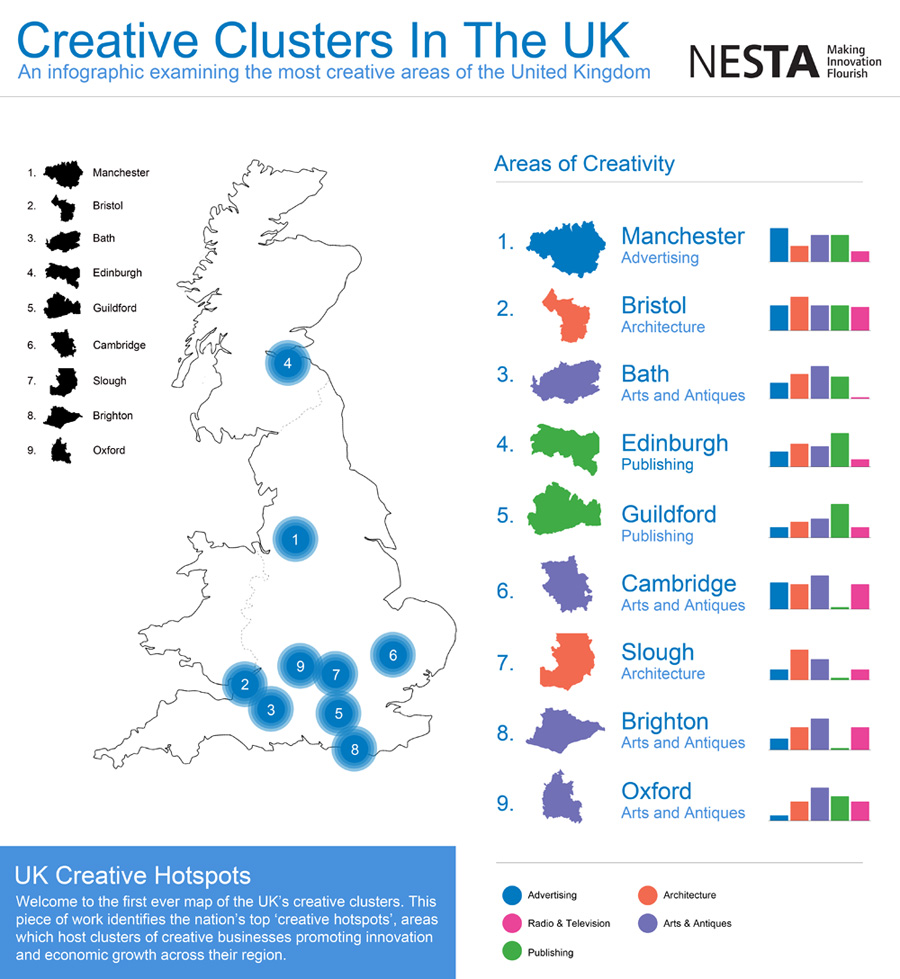
Creative clusters and innovation

Putting creativity on the map

NESTA research report 2010

NESTA is the National Endowment for Science, Technology and the Arts - an independent body with a mission to make the UK more innovative. NESTA invests in early-stage companies, informs policy, and delivers practical programmes that inspire others to solve the big challenges of the future.

Their report into Creative Clusters, published in November 2010 makes interesting reading for both businesses looking to foster creativity within their organisations, as well as policy makers and planners looking at creativity locally and nationally.

The creative industries are a force for innovation at the national, regional and organisational level. At 6.2 per cent of the economy, and growing at twice the rate of other sectors, the economic importance of the creative industries to the UK are proportionately the largest of any in the world. Nurturing high-technology clusters can also be seen as a way of rebalancing the economy away from the construction and financial services sectors.

The UKs creative industries are more innovative than many other high-innovation sectors, providing a disproportionate number of the innovative businesses in most parts of the country. Analysis of the innovation performance of Britain’s creative industries confirms that they punch well above their weight in terms of innovation across almost all regions in the UK.

NESTA took the concept of creative clusters as a starting point to examine the role that creative industries play in local and regional innovation systems.

Industrial clustering benefits businesses by giving them access to skilled staff and shared services, and the opportunity to capture valuable knowledge spillovers.

Creative firms tend to locate close to each other even more than
most other sectors. Advertising and Software firms often cluster near each other; the same is true of Music, Film, Publishing and Radio and TV businesses.

Creative hotspots
London is at the heart of the creative industries in Britain, dominating in almost all creative sectors, and particularly in the most intrinsically creative layers of the value chain for each sector.

The nine other creative hotspots across Britain are Bath, Brighton, Bristol, Cambridge, Guildford, Edinburgh, Manchester, Oxford and Wycombe-Slough.

Different cities across Britain have different profiles of creative specialisation: cities across the South present more diversity in their range of creative services, whereas Northern and Midlands cities (Manchester excepted) have similar creative profiles.

However, the mere existence of a creative agglomeration is not enough for the benefits from clustering to emerge. The other crucial ingredient is connectivity between firms within a cluster, with collaborators, business partners and sources of innovation elsewhere (both in the UK and overseas), and finally, with firms in other sectors that can act as clients, and as a source of new and unexpected ideas and knowledge. These three layers of connectivity are underpinned by a dense web of informal interactions and networking.

NESTA’s report identified a range of proactive steps that can be taken to help boost creativity internally, locally and nationally;

Look for latent clusters rather than try to build new ones from scratch
Identify whether there are any latent clusters ‘hidden’ in your locality that would benefit from networking and awareness-raising to develop a dense web of internal and external links.

Think about which sectors work well together
There are important synergies between some creative sectors, but not others. Avoid potentially wasteful ‘one-size-fits-all’ strategies for creative clusters that don’t pay sufficient attention to the distinctive needs of different sectors.

Adopt better targeted, and more realistic strategies that focus on ‘building up and connecting’ those sectors that are already present – and are complementary with each other.

Technological innovation is increasing the potential impacts from the creative industries…
The creative industries do not have a monopoly on creativity, but neither do manufacturing and engineering have a monopoly on technological innovation.

Universities should do more to promote innovation in increasingly tech-intensive creative industries
Technology intensive creative industries, for example, have something to gain from tapping into the public research base in their local universities.

In the context of the creative industries, universities tend to be seen mainly as a source of skilled labour. This contrasts with the technology and science-based sectors, where universities are a crucial source of knowledge for innovation, as well as high-growth spinoffs. It is important to ensure that the local creative industries engage more actively with universities to harness research outputs that might enhance their productivity and innovative performance.

Nurture talent, and give it reasons to stay
The presence of a specialised and knowledge-intensive pool of labour is a key factor in business.

Help remove barriers to collaboration
Even if they are aware of each other, local creative businesses may be keen to protect their valuable ideas or client portfolios and be wary of collaborating for fear of disclosing sensitive information.

Capture creative value locally

The generation of original intellectual property (IP) is at the core of what many creative businesses do. Where they retain ownership over their IP, they have more incentives to innovate to exploit it, generating additional revenues that can be reinvested in growth, and building commercial and collaborative relationships with other local firms.

Build bridges as well as towers
Although investments in iconic public buildings can produce undoubted cultural and economic benefits, building links between potentially collaborative businesses and sectors may produce longer lasting impacts.

East London Tech City as the beginning of a new approach for creative cluster development?
The Prime Minister’s announcement (in November 2010) of the East London Tech City set of initiatives, aimed at building up the vibrant high-tech and digital media cluster in Old Street and Shoreditch is a step in the right direction. Rather than trying to create a new cluster from scratch, East London Tech City aims to take an organic, already competitive cluster to the next level, by providing it with the right infrastructure (both physical and digital), and developing its connections with global companies.

Monday, 7 February 2011

Ideas

Visual communication depends on creativity taking place with a framework. You can’t give your imagination free reign because you have to come up with ideas about your subject in a context that will not confuse the receiver.

But working with a framework need not stifle creativity. Restrictions provide something to react against, or a tradition to break. The challenge is in pushing the boundary but not necessarily exceeding it.

Most people would agree that creativity means challenging conventions and producing, or being open to, new ideas. Of combining things that are not normally associated together in different or unexpected ways to create something new and exciting.

A good idea is a thought that may offer a new overview of a communication problem, or a starting point for a new solution. Often it adds something new to the message through the wording or design.

A successful idea captures attention and invokes an emotional response. It should be simple and clear and have the capacity for further development.

Practical creativity often follows a familiar pattern that starts with an insight to the nature of the communication problem to be solved, establishes and clarifies the goals that you are trying to achieve, involves a period of desk research or mystery shopping to understand the context of the problem and the target audience, before finally generating ideas and reviewing their value and currency.

Thinking laterally about applying new information or providing a different context to your message is important in creativity. Avoiding habitual solutions by finding a new perspective or angle on a familiar problem allows the creative thinker to see things in a new light.

But where do ideas come from? There are two levels of dialogue that can take place, internal within the creative mind and external with your colleagues. Unlocking those dialogues involves breaking strong forces of internal and external habit. Everyone must feel able to think and to voice ideas that may be unworkable or plain daft.

Tricking your brain into avoiding self-censorship for fear of criticism or rejection often involves using creative tools or role-play. These techniques may include;
  • Brainstorming – Ideas by association where all suggestions are welcome
  • Nine boxes – your problem in the middle, eight possible solutions around the outside. Take each idea in turn and repeat.
  • Opposites – ideas using opposites and conflicts
  • Six thinking hats – Edward de Bono’s classic methodology
  • Sketching – drawing often triggers new ideas
  • Starting at the end – work backwards to discover the prerequisites for success
And finally, there’s your idea, ready to be developed and tested and grown into a full creative solution.

As an untried solution to a problem, your idea only becomes meaningful when it is applied to the communication problem. But when your idea successfully addresses problem, is in line with the goal of your client, reflects the vision and values of their business and is capable of being deeply embedded in all communication channels, then you have your creative solution.

Wednesday, 19 January 2011

This is Tomorrow

And so to the Whitechapel Gallery to see This is Tomorrow, an account of the production process of this seminal exhibition.

During the 1950s mass production and new technologies were celebrated by the Media. Novel materials were to influence all areas of life, from the daily maintenance of living spaces and the built environment as well as the production of art.

Architect, writer and founder member of Pentagram Theo Crosby’s initial idea for an exhibition involving architects, artists, designers and theorists resulted in This is Tomorrow, which took place at the Whitechapel in 1956 in collaboration with members of the Independent Group. The theme was the ‘modern’ way of living and the exhibition was based on a model of collaborative art practice. The 38 participants formed 12 groups, which worked towards producing one artwork.

Just What Is It that Makes Today’s Homes So Different,
So Appealing? © Whitechapel Gallery
  
One of the group members, Richard Hamilton, produced his 1956 collage Just What Is It that Makes Today’s Homes So Different, So Appealing? for the exhibition. It is considered by critics and historians to be one of the early works of Pop Art.

An iconic show in its conception and realisation it has continuously interested artists, theorists and curators ever since due to the challenge it posed for the creative practitioners and visitors alike. The former, as each group was formed by an architect, a designer, an artist and a theorist, were requested to amalgamate their individual approaches and produce a work by deploying a new methodology. The public, with no interpretation panels and other information available, had to make their own judgements as to how to navigate inside the gallery and interpret the works they viewed.