Showing posts with label Creativity. Show all posts

Wednesday, 4 October 2017

1,516 mass shootings in 1,735 days

1,516 mass shootings in 1,735 days: America's gun crisis – in one chart

The attack at a country music festival in Las Vegas on Monday 2 October 2017 that left at least 58 people dead is the deadliest mass shooting in modern US history – but there were six other mass shootings in America in the previous week alone.

Data compiled by the Gun Violence Archive reveals a shocking human toll: there is a mass shooting – defined as four or more people shot in one incident, not including the shooter – every nine out of 10 days on average.

The graphic, produced by The Guardian US interactive team, a small group of designers, interactive developers and journalists working alongside the editorial team, is horrifying in it's simplicity.


A simple but effective idea demonstrating the power of information graphics to tell a story. As you scroll down, the enormity of the carnage over the last four years becomes apparent, leaving you slack-jawed at the seemingly never-ending toll - an infinite scroll of injury and death.

Thursday, 21 September 2017

Can Graphic Design Save Your Life?

And so to the Wellcome Collection, and their exploration of the relationship between graphic design and health Can Graphic Design Save Your Life?.

The exhibition highlights the widespread and yet subliminal nature of graphic design in constructing and communicating healthcare messages; words and images, signs and symbols, colour, scale and format, all carefully structured to communicate, and in doing so shaping our environment, society and personal health.

Creating a health message that an individual is willing to self-identify with, and consequently inspire action or change their behavior, requires a range of design interventions. Surprisingly, sometimes a small structural change can create the greatest impact.

For example, ‘nudge’ theory suggests that presenting people with a mandated choice or opt-out question makes it significantly more likely that they would choose to carry an organ Donor card.

The exhibition is divided into zones; persuasion, education, hospitalisation, medication, contagion and provocation.

Each of which explain one aspect of design in health, from national public awareness campaigns such as those for AIDS (TBWA) and the Samaritans (BBDO), to design research such as the NPSA’s findings on improving pharmaceutical packaging design and patient safety (RCA’s Helen Hamlyn Centre for Design).

I enjoyed seeing Dr. John Snow’s historic map of cholera deaths around the Broad street pump, and Florence Nightingale’s ‘rose’ charts to illustrate deaths from disease in the Crimea, classics of information design.

On a larger scale, the sympathetic A&E information and wayfinding system for the NHS (Pearson Lloyd) and the now ubiquitous emergency service ‘battenburg’ patterns (PSDB) are reminders of how effective design ideas quickly spread and become an accepted part of the environment.

Whether taking the correct tablet, deciding to donate an organ or to practice safe sex, graphic design influences our health and wellbeing. Can Graphic Design Save Your Life? considers just how vital graphic design can be.


Saturday, 19 November 2016

Type talks

We know that typefaces convey emotion as well as information.

Sarah Hyndman’s talk at the Museum of Packaging set out to explore the connections between social change, popular sentiment and typography.

In a time of increased industrialisation and globalisation, where jobs and livelihoods are threatened, where an influx of labour from elsewhere depresses wages, where old certainties are stripped away as financial systems, social order, and country borders are threatened. New leaders articulate a radical vision of the future, whilst those outside of the elite look on powerless and in search of a voice.

Sound familiar?

In 1970 the raw anger of a generation that felt excluded, marginalised and ignored found their voice in Punk. Expressed through attitude, music, style and typography, Punk’s anti-establishment stance found its visual expression through the work of Jamie Reid.

The stylistic conventions of Punk included mixing type styles and weights, overprinting, cluttered pages, deliberate mistakes, cultural references, blurred photography and an embrace of general messiness. All elements that rejected the rules and structure of the international style, took the typographic grids of modernism, a visual shorthand for the corporate industrial complex, and tore them apart.

Treating type as if it was a photograph freed designers from the restrictions of typesetting within a structured grid. Cut-out, photocopied and hand-drawn type also had the advantage of being able to bypass expensive printers, the rawness of the layouts on labels, flyers and zines perfectly matching the urgency and language of the authors.

 Ironically, the vibrancy of the look led to it becoming co-opted by the very establishment that Punk aimed to subvert. First ignored and feared, then embraced and tamed.

Kellog’s Squares anyone?

The creation of an expressive style that symbolises opposition to the establishment has historical precedent, and the inevitable co-option of anti-establishment typography into the mainstream follows a similar pattern. First World War Germany saw the appearance of Dadism. 1960’s America brought us psychedelia and pop art against the backdrop of the Vietnam war. The industrial decline of The UK in the 1970’s gave rise to Punk, whilst the 1980’s brought New wave and the postmodern typographic design of Brody, Saville, 8vo and Tomato (amongst others).

And so to 2016, and the rise of the Snapchat generation. With one typeface, limited tools and only a 10 second viewing window, Snapchat is the latest medium for millennials to share the moments that matter to them. it’s really immediate and ugly. You’re not designing, it’s just Times New Roman or Ariel and then it’s gone. It’s the closest thing now to how Punk looked like then.

Unstructured information and emotion that is explicitly short-lived and self-deleting, so it can’t be filtered, searched, indexed or saved, but provides today's authentic voice.

Sunday, 18 October 2015

In search of the lost logo

It’s not often that I get my name mentioned in the same sentence as two of my design heroes, so thanks to Paul Mellon for posting an update to his search for the (as-yet-unknown) designer of theNeighbourhood Watch logo.


The design neighbourhood really stepped up to support our quest to locate the original designer of the NW roundel. Design journalists such as Lynda Relph-Knight and some of the UK’s pre-eminent designers from the 80’s and 90’s era, such as Mike Dempsey, Studio Dempsey and Michael Johnson, Johnson Banks joined in the search as did ex-employees of the COI in-house design studio, such as Fanny Sigler, Mike Wheeler and Rob Levison who actually put us onto our strongest lead.

Whilst the identity of the original designer remains elusive, Paul goes on to cite Creative Barcode as a method of identifying the originator of creative works that goes beyond simple copyright watermarks.

In the same way that map makers use ‘paper villages’ to identify when their work has been plagiarised, Creative Barcode is a way for creators, entrepreneurs, innovators and brand owners to use Intellectual Property (IP) tags to protect their ideas, concepts and designs.

Part of the value inherent in the value of a brand is its original instance, its history and and subsequent design journey.

By ensuring a design history is maintained, Creative Barcode records, authenticates, time-stamps and IP tags iterations of a design and its creative expression.


The designer should therefore always be identifiable and credited in the Creative Barcode time-line.

So whilst it has become easier for creatives to promote their work by putting their portfolios online, being able to timestamp work and identify yourself as the creator is increasingly important in an industry where ideas are the main currency and it is easier than ever to ‘borrow’ other designers work for creative inspiration.


Saturday, 25 July 2015

Structured thinking is a competitive advantage

The process of design calls for a combination of investigation, strategic thinking, design excellence and project management skills.

But regardless of the nature of your client and the complexity of their project, the process should remain the same.

By breaking a project down into distinct phases, each with defined beginning and endpoints, you create logical breaks for review and decision making.

Reinventing the process each time in order to cut costs can create substantial risks to the project, and negate any long-term benefits.

Larger firms may follow a controlled and documented process, such as PRINCE2, whilst smaller agencies may have a simple five-stage plan, but in either case having a structured process appropriate to the task provides competitive advantage by:
  • assuring that a proven method is being used to achieve business results;
  • sharing the understanding of the time/cost/quality required;
  • creating trust and confidence in the project team;
  • positioning project management as smart, efficient and cost-effective;
  • building credibility for the proposed creative solutions; and
  • setting and managing expectations for the process.

However it is expressed, the design process can be seen as just a more complex version of the simple ‘story hill’ that is taught in primary school.

You need a beginning, a middle and an end, and within that you need to ask what needs to happen (and in what order) and how are things resolved?

But because the process is just the process, you still need a creative spark, intuition or leap of faith to bring it to life.

Having a structure in place lessens the background ‘noise’ and creates the space in which creative thinking can thrive.

Thursday, 20 November 2014

Design by algorithm

Logos that change based on external variables

The tension between the desire for uniformity and the need for originality has provided a rich seam for branding agencies to exploit.

The idea that the essence of visual design can be expressed via a universal set of rules has a rich history, from the greek golden section via vetruvian man, compositional techniques, and the typographic grids of modernist typography.

But whilst brands can be monolithic or flexible, their visual expressions remained fixed until the 1980’s when the introduction of desktop publishing made it possible to produce designs that change based on external variables.

Some brands might need to show diversity of service or product, while others see flexibility as a crucial competitive advantage. So for those organisations that have evolution written into their essence, a dynamic identity provides an exciting and relevant structure for brand expression.

NAI
A radical scheme for the NAI (Netherlands Architecture Institute) by Bruce Mau provided many distorted, out of focus logos that allowed for flexibility and experimentation. Soon after, the Tate Gallery took the NAI’s lead and introduced an ever-changing logo for its ever-changing displays (courtesy of Wolff Olins).

Less successful was Abbey National’s 2003 ‘soft and fuzzy’ rebrand, ditched when Santander acquired the bank, but Wolff Olins returned to the idea of flexible brands, with a more controlled iteration in PWC’s device-friendly identity where a set of translucent rectangles flex and change depending on their usage.

PWC's flexible branding
However, logo selection is often made from a tightly controlled master set rather than from dynamically created marks.

Now, the use of the algorithm has enabled the rise of tailored design, where application of a consistent set of rules to a dynamic data set produces a unique output - design expressed as art.

A recent example of this genre is MIT Media Lab’s development of its flexible identity. Created by Pentagram, and based on the same grid as its predecessor, its aggressive pixelated letterforms create an uncompromising set of marks with echoes of Wim Crouwel’s New Alphabet.

It’s not a beautiful logo, but as the visual expression of the Media Lab’s multiple research groups at the core of its academic structure, it fits.

Lockups of two characters within the grid allow for almost every possible letter combination— “an algorithm” explains Pentagram, “will generate all the possible solutions for any given group acronyms in the future.”


This visual language sets the tone for a highly flexible range of applications and future permutations of the identity that will have the same look and feel without having to be the same.

In a more sensitive use of the pixel-block style, Norwegian design studio, Snøhetta, has designed the obverse of Norges Bank new bank notes. The design, based on the boundary where sea, shore and sky met, renders images from the Norwegian coastal landscape in a Minecraft-like pixellated form, the degree of distortion related to the ‘windspeed’ that increases with each denomination.

On the 50 kroner note the wind is weak, so the boundary between sea and coast is rendered in calmer short, square shapes; while on the 1,000 kroner note the wind is strong, creating longer, stretched-out forms that allude to rolling breakers and windswept trees.


But whilst Snøhetta uses the idea of windspeed to create the pixel distortion, the execution is static. A 2010 scheme for Nordkyn from Oslo’s Neue Design Studio, also using data based on the feed from the Norwegian Meteorological Office, produces a new logo dynamically for every application.


http://horizons.dandad.org/
Although not strictly speaking a logo, D&AD’s 2013 Annual used a similar methodology to create ‘identities’ that reflected the global spread of winners at the D&AD Awards. The algorithm creates a unique composition based on longitudinal and latitudinal location data, with colours chosen by time, and meteorological data used to determine the hue

Where an entry lacks a suitable data feed to produce dynamic data, use of a picker to sample random colours from an image can provide the necessary random variable.

ITV colour picker
Similarly, ITV’s rebrand created the opportunity to tailor the colour palette of the logo using key colours and tones from the programme being promoted, so popular entertainment gets a vibrant palette, whilst the logo can take on a more sombre appearance when the programming (or news) requires it.

As well as colour, shape can have an influence. Sagmeister’s identity for Casa Da Musica needed to echo the exuberance of the architecture because ‘as we studied the structure, we realized that the building itself is a logo’.

Casa Da Musica dynamic logos
The essence of the brand identity was to illustrate the many different kinds of music performed, through an algorithm that paired colours sampled from a composers image with different facets of the building. Depending on the music the logo changes its character and works dice-like by displaying different planes and hues.

Sound can also be used as the dynamic element.

Precedent’s work for the Leeds College of Music, using a tool created by Karsten Schmidt, allows staff and students to create their own visual identity by inputting visualisations of their own music to create their own unique sound signatures to use in graphic applications.

Arguably, those dynamic designs that incorporate a random element into the algorithm achieve a more aesthetically pleasing result, negating the principle of the application of a universal rule.
But because many audiences will only see a single iteration of a dynamic identity system, it follows that if any individual variant is weak, the overall identity suffers. For the overall brand to be successful, the pieces need to equal the whole.

So the key question to ask of any dynamic identity is whether it accurately expresses the brand in all its executions.


Monday, 22 September 2014

Big design

gov.uk
When the award-winning gov.uk site launched in 2012, it marked the moment ‘big design’ entered the mainstream.

Driven partly by the need to be accessible, and partly by the requirement to work on mobile devices, the launch of gov.uk also coincided with the design industry moving from skeuomorphic design towards the flat aesthetic seen in Microsoft’s Windows 8 ‘Metro’ interface, Apples iOS8 and Google’s Materials Design.

This combination of HTML5 dynamic backgrounds, overlayed with large type and control icons on flat colour panels has created a youthful ‘flat’ UI design meme that references the Bauhaus and Swiss Design schools and provides a single underlying system providing a unified experience across platforms and device sizes.

The new BBC responsive website, now in beta testing, follows the same principles.


BBC Beta

Every week, the BBC News website gets around 115 million visits, and the number coming from mobiles and tablets is increasing all the time to the point that these devices now account for 43% of unique browsers.

Looking at device usage, it seems clear that the increased take up of tablet and mobile devices, with their requirement for larger button target areas, is driving the move towards ‘big design’.


Apple iOS7
For any organisation, maintaining different versions of websites for desktop, tablet and mobile (as well as accounting for different screen sizes, different browsers and legacy systems) is unsustainable. Designing simpler responsive sites, optimised for different screen sizes, is the most efficient structure, but it means that control areas designed for display on mobile devices take up a proportionally larger area of screen when displayed on a desktop device.


Microsoft Metro/Windows8
Google Material Design
This also represents a shift in the way websites are designed. In the early days of the web, websites were merely ‘brochureware’ extensions of printed publications. (The first web page I designed for the DTI just had a telephone number on it.) Then came sites that replicated the (sometimes labyrinthine) internal structure of an organisation. In the third wave these sites were turned around to be more user-centric.

Now we are seeing the rise of more focused task-centric sites, and enabling users to carry out these tasks (often on the move) using a simple graphic UI that stands out from the background visual noise is a major driver in big design.

But in deploying large blocks within your content, the challenge now for a designer is how to develop the visual structure without losing a sense of style.

The resolution of mobile screens means that good typography, tracked and spaced with as much precision as print, is now achievable. Icons and other UI elements don’t need candy stripes or glossy reflections to make them look better at low resolutions.

So while it’s good to know what best-practice is, it’s possible for designers to push the boundaries, because we can.


Friday, 15 August 2014

In These Stones Horizons Sing

Continuing the theme of a visual language being structured by an overarching idea, graphic design can learn a lot from looking at architecture.

Wales Millennium Centre
The Wales Millennium Centre was designed and built in Wales. The brief to the architects, Percy Thomas, was that it had to be unmistakably Welsh and internationally outstanding.

Wales’ identity is conveyed through the materials used to build the Centre. They connect to Wales’ culture, landscape, and history.


The exterior walls are clad in horizontal layers of welsh slate, inspired by the architects’ memories of the stratified cliffs along Wales’ Glamorgan coastline around Ogmore and Southerndown.

This visual language ties the building to the Welsh landscape, and the structure of the fascia and colonnades also echoes the tunnels and galleries of the mines that once dominated Welsh industry.

You can see the clear line of thought that developed from the architect’s sketch books through the design drawings to the finished building. The success of translating the architects vision into a structure with a coherent visual language has produced a powerful statement of Welsh identity.

Tuesday, 29 April 2014

Just what was it about Richard Hamilton?

Just what is it that makes today’s homes so different,
so appealing?
Visiting the retrospective of Richard Hamilton at Tate Modern, I was struck by the way he constantly embraced new ideas in his art, and experimented with different drawing, painting, collage and printmaking methods and latterly digital techniques.

Hamilton took a very experimental approach to art, exploring the boundary between figurative and abstract images and the interface between organic and industrial forms.

In 1951, for his exhibition Growth and Form at the ICA, Hamilton used grid-based structures to look at form in nature and explore their influence on design trends in contemporary architecture and design.

In the seminal 1955 Man, Machine and Motion exhibition at the Hatton Gallery in Newcastle and then at the ICA, Hamilton arranged around 200 images in a modular steel grid. The viewer was encouraged to explore the installation and see images around, above and below them.

His developing interest in popular culture led to the creation of the collage seen as the first Pop art work, Just what is it that makes today’s homes so different, so appealing? Hamilton listed the characteristics of Pop art;
  • designed for a mass audience
  • transient
  • expendable
  • low cost
  • mass produced
  • young
  • witty
  • sexy
  • gimmicky
  • glamorous
  • big business
Effectively he was describing the next 50 years of modern advertising.


Tuesday, 19 November 2013

Investing in design

Design Council research has shown that for every £1 that businesses invest in design, they gain on average over £4 net operating profit, over £20 net turnover and over £5 net exports.

And there is increasingly widespread awareness in industry that when the remit for design is widened beyond the traditional focus on products or graphics to provide benefits such as improved strategic thinking, morale and productivity, then design can add significant value to organisations.

A new report, Leading Business by Design, suggests that rather than being a method solely for creating desirable objects, design can be fundamental to businesses in helping them innovate and define strategy.

The report was commissioned from Warwick Business School by the Design Council, and came up with three main findings;
  1. Design is customer-centred – Benefit is greatest when design is intimately related to solving customers’ problems.
  2. Design is most powerful when culturally embedded – It works best when it has strong support from senior management in the commissioning organisation, and is integrated into product / service development from beginning to end.
  3. Design can add value to any organisation – Design can benefit small, medium or large manufacturing and service-based organisations by driving innovation and opening up uncontested market spaces, differentiating products and services to attract customers, and improving recognition by strengthening branding to embody a company’s values.
Using case studies, the report provides practical examples of how these three design themes have benefited a range of organisations, and provides clear evidence that structured design thinking offers a set of widely applicable principles that can be of huge benefit to all businesses.

Essentially, it suggests that rather than being a method solely for creating desirable objects, design can be fundamental to businesses in helping them innovate and to define strategy.

Tuesday, 5 November 2013

Less than one second


Paul Butt / Section Design
Structuring and visualising data is a discipline that always appeals to me, so it was with a sense of anticipation that I took a trip to Shoreditch to see a two-day exhibiton of information and data design curated by London based information design agency, Signal Noise.

Signal Noise commissioned a series of print-based data visualisations that explored the theme of “less than one second”, based on the premise that time is of the essence now more than ever before.

We now access enormous reams of data in ‘less than a second’, thanks to technologies such as cameras that captures the movement of light in slow motion, or the Large Hadron Collider (LHC) that observes sub-atomic activity happening in millionths of a second.

Technology enables a vast number of data points and events to be read and understood across a variety of fields - from automated trades to F1 analytics - but filtering and making sense of the data so that it provides a useful insight is the job of the information graphic designer.

Despite the wide range of subjects used as source material for the exhibition, including athletics, cinematography, F1, GPS, the LHC and stock trading, I found it significant that the base structure of the majority of the visualisations was circular.


Mapping the data - Josh Gowen
The visualisations that eschewed circles were, I thought, less intuitive and less visually attractive, even though timelines are traditionally depicted as, well, a line.

Imposing a clock face metaphor seemed to provide a familiar ‘carrier’ structure for the message, enabling the viewer to quickly interpret the information.

The most successful visualisation seemed to me to be Josh Gowen’s ‘Mapping the data’, combining the clock metaphor with the shape of the LHC and a graphic that showed how the volume of data crunched by the LHC is filtered and then delivered to 151 research centres worldwide.

Telling the story by combining seven pieces of information in one graphic, plus some cool stats. What's not to like?

Sunday, 27 October 2013

Phonebloks

On Tuesday 29th October the Phonebloks video will ping across social networks 375 million times.

Phonebloks is a new concept for a mobile phone with a replaceable screen and easily moveable, changeable “bloks”, each containing a different element such as battery, chipset, gyroscope and so on that would give users a chance to choose from a range of components, and replace or upgrade them when necessary.

A phone only lasts a couple of years before it breaks or becomes obsolete. Although it’s often just one part that killed it, we throw everything away because it’s almost impossible to repair or upgrade.

The idea, by Dutch designer Dave Hakkens, came about when Hakkens realised that if a device could be taken apart and restructured more easily it would last much longer (and minimise electrical waste).

And so the idea of Phonebloks was born.

Phoneblok is made of detachable bloks. The bloks are connected to the base which locks everything together into a solid phone. If a blok breaks you can easily replace it; if it’s getting old just upgrade.

Bloks can be developed for specific needs. Solar powered batteries, sensitive screen for blind people, lightweight for travelers etc.

“Let’s say this is your phone and you do everything in the cloud - why not replace your storage blok with a bigger battery blok?” says Hakkens. “If you’re like this guy and love to take pictures, why not upgrade your camera?”

The bloks themselves would be available from a ‘Blokstore’, like an app store for hardware. In the store you buy your bloks, read reviews and sell old bloks. Small and big companies develop and sell their bloks. You can buy a pre-assembled phone or assemble it yourself by selecting the brands you want to support. The choice is yours.

And the platform can be adapted into other sizes to create new devices like tablets, cameras etc.

But at the moment, it’s just an idea.

For Phonebloks to happen, it totally depends on companies thinking there is a market for it, so the more people that are interested, the sooner companies start working on it.

Thursday, 19 September 2013

‘I love Comic Sans’


And so to hear Bruno Maag speak at London Design Week’s Sound and Type lecture in the glamorous environs of the Soho Hotel Screening Room.

His opening statement, that he ‘loves Comic Sans’, drew a predictable hiss of outrage from the designers and typographers in audience, but the point Bruno made is that Comic Sans is completely appropriate for its original purpose, comic book style lettering for speech bubbles in the programs MS Bob and MovieMaker

Comic Sans has a characterful letterform that connects, perfect for supporting letter recognition in early learning (and useful for dyslexics too).

So how do you engage audiences visually and emotionally with your brand? What are the essential elements that make your brand unique? How do you create bespoke tools that set your brand apart?

The challenge presented to branding in the global marketplace is maintaining the brand look and feel across all touchpoints in all markets.

Think ‘international’, and designers reach for their tried and trusted sans serifs, but where’s the emotional connection in the international style?

Remember that the ‘modern’ typeface Helvetica was cut in the 1950’s (itself based on the grotesque faces of the late Victorian 1900’s), putting Helvetica well into middle-age.

Instead, make an informed choice of typeface, one that expresses your brand values and connects visually and emotionally with your audience, a typeface that can be placed right at the heart of your brand.

Global companies, such as HP, see investment in a bespoke typeface as a key part of supporting their brand experience worldwide.

But relying on the Western European character set no longer cuts it. Fonts need to accommodate Arabic, Chinese, Cyrillic, Greek, Indian and Thai characters.

Designing a font for the Chinese market means creating 27,500 glyphs alone and can take up to two years.

And that’s before you take into account Hong Kong and Taiwanese Chinese.

Font design is a major investment, but the recognition value that an appropriate font brings to a brand makes it arguably worthwhile.

Just don’t use Comic Sans unless you’re designing a comic.

Wednesday, 17 October 2012

The Big Draw 2012

At the V&A for The Big Draw, I attended one of the seminars given by Heatherwick Studios.

The main theme was about the importance of sketching in order to structure your design thinking.

Guggenheim Bilbao - Frank Gehry
Quick sketches made with your client on site are a great visual shorthand that can be developed later in the studio. The challenge is to keep the energy of those initial sketches as the design goes through various iterations and refinement on drawing boards, computer and CAD systems.

Sketching elevations and floorplans, page layouts or wireframes conveys much information that would be lost if the same information was provided as a narrative. Sketches are easier for both the layman and expert to interpret and so understand the vision of the designer.

East Beach Cafe - Heatherwick Studio

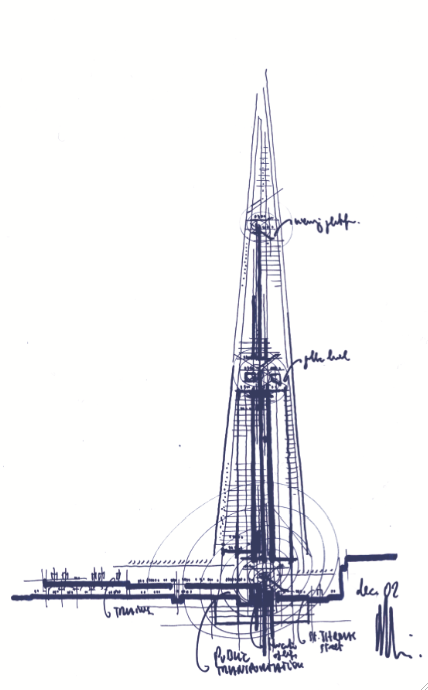
And with the increasing number of competitions and awards that require a story arc, anecdotally, many designers are going back at the end of a project to retrospectively create that all important ‘back of the napkin’ sketch that inspired the project in the first place (with apologies to Renzo Piano).

The Shard - Renzo Piano

Now, where did I put my pencil…

Wednesday, 7 March 2012

A periodic table of visualisation methods

© Ralph Lengler & Martin J Eppler


Like the London tube map, the periodic table is frequently used as a structure for classifying other collections.

This classification of visualisation methods works surprisingly well and displays some useful visual examples on rollover.

Tuesday, 10 January 2012

*Santa*™

Its a bit late for this Christmas, but I came back to find a link to the Santa Brand Book from Quietroom in my inbox.

Ho, ho ho!

Monday, 21 November 2011

Nine box brainstorming

A great technique for quickly generating ideas is to use nine-box brainstorming.

Draw a grid of nine boxes – like noughts and crosses (tic tac toe if you’re in the US) – and put your subject in the centre box.

Now fill the eight boxes that surround the centre box with ideas, one idea per box.

Take each idea, and place it in the middle of a new nine-box grid. Into each of the eight surrounding boxes put either a development of the idea or a visual treatment.

That’s 64 possible routes within 30 minutes.

Wednesday, 28 September 2011

The Power of Making

‘Alphabet’, pencil-tip structures, Dalton Ghetti, USA.
Photo by Sloan T. Howard Photography
And so to the Power of Making exhibition at the V&A. Making is the most powerful way that we solve problems, express ideas and shape our world. What and how we make defines who we are, and communicates who we want to be.

For designers, making is a chosen vocation: a way of thinking, inventing and innovating. It’s a delight to be able to shape a material and say ‘I made that’.

I particularly liked the way materials have been juxtaposed so that the soft ‘fur’ of an animal or dress is composed of hard metal, or a robot exoskeleton made of wood.

Every object in this exhibition has been made by adding, subtracting or transforming material, or by combining these processes.

Many people think that craft is a matter of executing a preconceived form or idea, something that already exists in the mind or on paper. Yet making is also an active way of thinking, something which can be carried out with no particular goal in mind. In fact, this is a situation where innovation is very likely to occur.

Even when making is experimental and open-ended, it observes rules and structure. Craft always involves parameters, imposed by materials, tools, scale and the physical body of the maker. Sometimes in making, things go wrong. An unskilled maker, hitting the limits of their ability, might just stop. An expert, though, will find a way through the problem, constantly unfolding new possibilities within the process.

Friday, 19 August 2011

The sound of 100,000 people chatting

Listening Post
And so to South Kensington where multimedia artist Mark Hansen and sound designer Ben Rubin have created a ‘dynamic portrait of online communication’ at the Science Museum.

Entering a darkened space, you find the work flashing and flickering as texts appear and disappear over grid of over 200 small electronic screens. There are seven ‘scenes’ and at intervals there is darkness and silence before Listening Post enters the next cycle of movement.

The sampled words and phrases are accompanied by ambient mechanical sounds. Combined, the work produces a form of mechanical poetry or music. The result presents a ‘sculpture’ of the ‘content and magnitude’ of online chatter.

"By sampling text from thousands of online forums, Listening Post produces an extraordinary snapshot of the ‘noise’ of the internet, and the viewer/listener gains a great sense of the humanity that sits behind the data. The artwork is world renowned as a masterpiece of electronic and contemporary art and a monument to the ways we find to connect with each other and express our identities online." Curatorial statement

We Feel Fine
Its a similar sort of idea to Jonathan Harris and Sep Kamvar's online project We Feel Fine, featured in the recent V&A Decode exhibition. The work comprises a database of recently posted blog entries that contain the phrase "I feel..." or "I am feeling...". In We Feel Fine, coloured blobs are assigned to emotions and the user is able to aggregate them into six structural concepts. The end result provides a snapshot of the World's feelings that can be interrogated across a range of socio-geographic data.

But whilst Listening Post has an air of industrial dystopian menace it is essentially passive. The ability to interact with the data in We Feel Fine presents a friendlier, more inclusive view of online chat.


Thursday, 26 May 2011

Effective images

How images are framed depends on the overall look and feel that the designer is trying to achieve, but there are various ideas that photographers – and painters – have found useful in creating effective images.

The selection, sizing and cropping of images is directly related to the accompanying text, in that they are either designed to illustrate the text, or the text provides an explanatory note to the image.

A common mistake is to use an image as it is provided, resulting in the use of poorly composed shots without a clear focal point or direction. Wheras any image can be made to work harder if the composition of subject elements is manipulated to communicate effectively with the intended audience.

There should be a good reason behind every image you select. Ask yourself;
  • Is your chosen image relevant and meaningful to the audience?
  • Is it right for the task and does it make the accompanying words work harder?
  • Will the combination of the words and pictures get the reader thinking?
  • Will the choice of image provoke the reader to do what you want them to do?
Designer and editor should work with a selection of close-ups, mid and long-range images. They should look to engage more directly with the subject matter and create interest through cropping, using orientation, symmetry or asymmetrical composition and the rule of three.

Cropping
Cropping is the easiest and most effective way to edit an image. This can change the whole emphasis of the shot by removing extraneous or distracting subject matter and manipulating the relationship between the subject elements and the edge of the frame.

Conversely a poor crop can ruin a good image. Be careful not to end up with a crop that is just slightly rectangular, as this communicates a sense of indecision.

Orientation
Picture shapes are normally dictated by the natural arrangement of elements. Landscape images tend to emphasise the relationship between subject elements to the left and right of the frame, whilst portrait images tend to relate background to foreground.

Choosing a landscape format for an image of a person, or using a portrait format for a landscape can produce an unexpected effect or pleasing juxtaposition.

Composition
People are predisposed to prefer symmetrical composition and this is the starting point for editing any image, placing the subject central in the frame. This signifies stability and strength.

However, symmetry can become monotonous and can lack movement. Asymmetrical composition places the subject off centre to create a more dynamic image with tension between the contrasting spaces around the subject.

The rule of three
The rule of three is a useful rule of thumb for asymmetric composition. Dividing the frame into vertical and horizontal thirds creates four ‘sweet spots’ at the intersections of the gridlines. Placing the most important elements of the image on or adjacent to these intersections can transform an ordinary image into one with a stronger composition.


Original image
Image divided into thirds
Image recropped with the subject positioned adjacent to the top right gridline intersection

Using these simple tools, a designer and editor can manipulate images in a structured way and get the most out of their pictures.